Khóa học
IELTS Online
IELTS Online
Giảm đến 18%
Đăng ký ngay
Mục lục [Ẩn]
“Developmental tasks of normal adolescence IELTS Reading” là một trong những bài đọc quen thuộc trong đề thi IELTS Reading, khai thác chủ đề tâm lý học và quá trình phát triển của thanh thiếu niên. Bài viết này sẽ giúp bạn hiểu rõ nội dung chính, từ vựng quan trọng, dạng câu hỏi thường gặp cũng như chiến lược làm bài hiệu quả.
Reading Passage
Undoing Our Emotions
Some years ago, Professor Robert Havighurst of the University of Chicago, USA, proposed that stages in human development can best be thought of in terms of the developmental 'tasks' that are part of the normal transition. He identified ten developmental tasks associated with the adolescent transition. Each of the Havighurst tasks can also be seen as elements of the overall sense of self that adolescents carry with them as they move towards and into young adulthood. Adolescents do not progress through these multiple developmental tasks separately; at any given time they may be dealing with several.
Physical Changes
The adolescent must adjust to a new physical sense of self. At no other time since birth does an individual undergo such profound physical changes as during early adolescence. Puberty is marked by sudden rapid growth in height and weight. Also, the young person experiences the emergence and accentuation of those physical traits that make the person a boy or a girl. The young person looks less like a child and more like a physically mature adult. The effect of this rapid change is that mid-adolescents are body-conscious, and their concerns are directed towards their opposite-sexed peers.
Intellectual Development
The adolescent must adjust to new intellectual abilities. In addition to a sudden spurt in physical growth, adolescents experience a sudden increase in their ability to think about their world. As a normal part of maturity, they are able to think more things. However, they are also able to conceive of their world with awareness. Before adolescence, children's thinking is dominated by a concrete example for any problem that they solve; their thinking is constrained to what is real and physical. During adolescence, young people begin to recognise and understand abstractions. The growth in ability to deal with abstractions accelerates during the middle stages of adolescence.
Academic Demands
The adolescent must adjust to increased cognitive demands at school. Adults see high school in part as a place where adolescents prepare for adult roles and responsibilities and in part as preparatory for further education. School curricula are frequently dominated by the inclusion of more abstract, demanding material, regardless of whether the adolescents have achieved formal thought. Since not all adolescents make the intellectual transition at the same rate, demands for abstract thinking prior to the achievement of that ability may be frustrating.
Value System
The adolescent must adopt a personal value system. During adolescence, as teens develop increasingly complex knowledge systems, they also adopt an integrated set of values and morals. During the early stages of moral development, parents provide their child with a structured set of rules of what is right and wrong, what is acceptable and unacceptable. Eventually the adolescent must assess the parent's values as they come into conflict with values expressed by peers and other segments of society. To reconcile differences, the adolescent restructures those beliefs into a personal ideology.
Verbal Skills
The adolescent must develop expanded verbal skills to accommodate more complex concepts and tasks. Their limited language of childhood is no longer adequate. As their conceptual development may outstrip their verbal development, adolescents may appear less competent than they really are.
Vocational Goals
The adolescent must establish adult vocational goals. As part of the process of establishing a personal identity, the adolescent must also begin the process of focusing on the question, 'What do you plan to be when you grow up? Mid-adolescents must identify, at least at a preliminary level, what their adult vocational goals are and how they intend to achieve them.
Personal Identity
The adolescent must develop a personal sense of identity. Prior to adolescence, one's identity is an extension of one's parents' identity. During the early adolescent years a young person begins to recognise their uniqueness and to establish themselves as separate individuals, independent of their parents. As such, one must reconsider the answer to the question, 'what does it mean to be me?' or "who am l?"
Emotional Independence
The adolescent must establish emotional and psychological independence from his or her parents, childhood is marked by strong dependence on one's parents. Adolescents may yearn to keep that safe, secure, supportive, dependent relationship. Yet, to be an adult implies a sense of independence, of autonomy, of being one's own person. In an attempt to assert their need for independence and individuality, adolescents may respond with what appears to be hostility and lack of cooperation.
Peer Relationships
The adolescent must develop stable and productive peer relationships. Although peer interaction is not unique to adolescence, it seems to hit a peak of importance during early adolescence. Certainly by late adolescence or early adulthood the need for peer approval has diminished. This degree to which an adolescent is able to make friends and have an accepting peer group, though, is a major indicator of how well the adolescent will adjust in other areas of social and psychological development. Early adolescence is also a period of intense conformity to peers." Fitting in' not being different, and being accepted seem somehow pressing to this age group. The worst possibility, from the view of the young teen, is to be seen by peers as different.
Behavioral Maturity
The adolescent must develop increased impulse control and behavioural maturity. In their shift to adulthood, most young people engage in one or more behaviours that place them at physical, social, or educational risk. Risky behaviours are sufficiently pervasive among adolescents to suggest that risk-taking may be a normal developmental process of middle adolescence. Gradually adolescents develop a set of behavioural self-controls through which they assess which behaviours are acceptable and adult-like.
Questions 1-6.
Classify the following developments as characterising
Write the correct letter, A, B or C, in boxes 1-6 on your answer sheet
1. becoming interested in people of the other gender..................
2. beginning to choose a future career..................
3. needing to feel the same as one’s friends..................
4. beginning to form a self-image separate from the family context..................
5. having less need for the good opinion of friends..................
6. exposing oneself to dangers..................
Questions 7-10
Complete each sentence with the correct ending, A-E, below.
Write the correct letter, A-E in boxes 7-10 on your answer sheet.
7. Havighurst proposed a set of tasks which..................
8. A course of study at high school..................
9. The speed of development of thinking ability during adolescence..................
10. Adolescence is a time when the young person..................
Questions 11-13
Do the following statements agree with the information given in the Reading Passage?
In boxes 1-5 on your answer sheet, write
TRUE if the statement agrees with the information
FALSE if the statement contradicts the information
NOT GIVEN if there is no information on this
11. Most pre-adolescent children are capable of abstract thought.
12. Adolescents ‘limited skills’ with words may give a false impression of their ability.
13. Whether or not an adolescent is accepted by their age-group is an important clue to other aspects of their social adjustment.
>> Xem thêm: Cách làm Gap Filling IELTS Reading “ẵm trọn” điểm cao
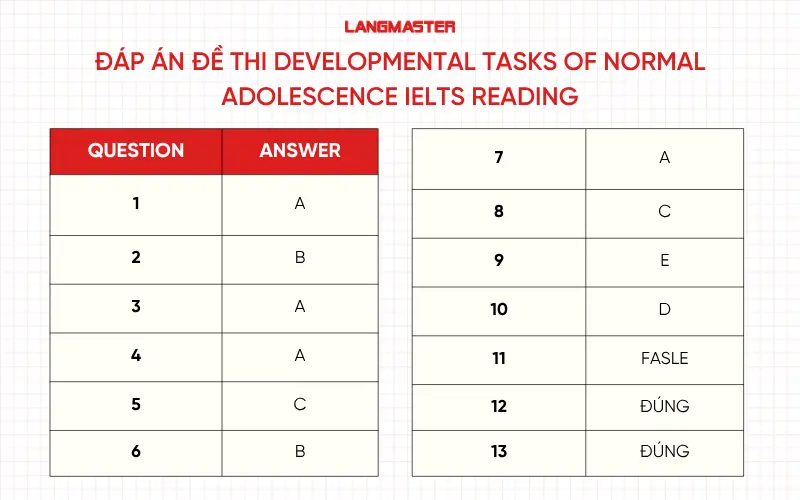
1. Đáp án: A. early adolescence
Giải thích: Trong phần Physical Changes, bài nói rằng “mid-adolescents are body-conscious, and their concerns are directed towards their opposite-sexed peers.” Điều này xảy ra ở giai đoạn đầu đến giữa tuổi dậy thì, nhưng cụ thể hơn là early adolescence khi cơ thể thay đổi mạnh và các mối quan tâm giới tính bắt đầu hình thành.
2. Đáp án: B. middle adolescence
Giải thích: Ở phần Vocational Goals, bài nêu “Mid-adolescents must identify, at least at a preliminary level, what their adult vocational goals are.” → rõ ràng đây là middle adolescence.
3. A. early adolescence
Giải thích: Trong Peer Relationships, bài viết: “Early adolescence is also a period of intense conformity to peers. ‘Fitting in’, not being different, and being accepted seem somehow pressing to this age group.” → early adolescence.
4. A. early adolescence
Giải thích: Trong Personal Identity, đoạn nói: “During the early adolescent years a young person begins to recognise their uniqueness and to establish themselves as separate individuals, independent of their parents.” → early adolescence.
5. C. late adolescence
Giải thích: Câu trong Peer Relationships: “Certainly by late adolescence or early adulthood the need for peer approval has diminished.” → late adolescence.
6. B. middle adolescence
Giải thích: Trong Behavioural Maturity, đoạn viết: “Risky behaviours are sufficiently pervasive among adolescents to suggest that risk-taking may be a normal developmental process of middle adolescence.” → middle adolescence.
7. A
Giải thích: Đoạn mở đầu nêu rằng:
“Each of the Havighurst tasks can also be seen as elements of the overall sense of self that adolescents carry with them as they move towards and into young adulthood.”
=> Những nhiệm vụ này phản ánh sự hình thành bản thân (self-perception) của thanh thiếu niên.
8. C
Giải thích: Trong phần Academic Demands:
“School curricula are frequently dominated by the inclusion of more abstract, demanding material...”
=> Chương trình học ở trung học được thiết kế ngày càng mang tính thử thách hơn.
9. E
Giải thích: Cũng trong phần Academic Demands:
“Since not all adolescents make the intellectual transition at the same rate...”
→ Mức độ phát triển tư duy không giống nhau giữa các cá nhân.
10. D
Giải thích: Trong phần Value System:
“Eventually the adolescent must assess the parent’s values ... and restructure those beliefs into a personal ideology.”
→ Đây là giai đoạn thanh thiếu niên hình thành hệ giá trị và niềm tin đạo đức riêng.
11. FASLE
Giải thích: Trong phần Intellectual Development, bài viết:
“Before adolescence, children's thinking is dominated by a concrete example for any problem that they solve; their thinking is constrained to what is real and physical.”
→ Nghĩa là trẻ trước tuổi dậy thì chưa thể tư duy trừu tượng, vì vậy câu nói “most pre-adolescent children are capable of abstract thought” là sai.
12. TRUE
Giải thích: Trong phần Verbal Skills:
“As their conceptual development may outstrip their verbal development, adolescents may appear less competent than they really are.”
→ Kỹ năng ngôn ngữ hạn chế khiến họ trông kém thông minh hơn khả năng thật, nên phát biểu này là đúng.
13. TRUE
Giải thích: Trong phần Peer Relationships:
“The degree to which an adolescent is able to make friends and have an accepting peer group is a major indicator of how well the adolescent will adjust in other areas of social and psychological development.”
→ Việc được nhóm bạn cùng tuổi chấp nhận là chỉ dấu quan trọng cho khả năng thích nghi xã hội → đúng.
>> Xem thêm:
Dưới đây là tổng hợp từ vựng IELTS quan trọng kèm nghĩa và cách dùng giúp bạn hiểu sâu và làm bài hiệu quả hơn đối với đề thi IELTS Reading Developmental tasks of normal adolescence IELTS Reading:
|
Từ vựng / Cụm từ |
Từ loại |
Nghĩa tiếng Việt |
|
adolescence |
noun |
tuổi vị thành niên |
|
developmental tasks |
noun phrase |
các nhiệm vụ phát triển |
|
transition |
noun |
giai đoạn chuyển tiếp |
|
puberty |
noun |
tuổi dậy thì |
|
body-conscious |
adjective |
ý thức về ngoại hình, cơ thể |
|
abstract thinking |
noun phrase |
tư duy trừu tượng |
|
value system |
noun phrase |
hệ giá trị, hệ thống niềm tin cá nhân |
|
peer relationships |
noun phrase |
mối quan hệ với bạn bè đồng trang lứa |
|
emotional independence |
noun phrase |
sự độc lập về cảm xúc |
|
vocational goals |
noun phrase |
mục tiêu nghề nghiệp |
|
behavioural maturity |
noun phrase |
sự trưởng thành trong hành vi |
|
risk-taking behaviour |
noun phrase |
hành vi mạo hiểm |
|
self-perception |
noun |
nhận thức về bản thân |
|
conformity |
noun |
sự tuân theo, hòa nhập với nhóm |
|
autonomy |
noun |
sự tự chủ, độc lập |
|
intellectual abilities |
noun phrase |
khả năng trí tuệ |
Trên đây là phần phân tích chi tiết bài Developmental tasks of normal adolescence IELTS Reading – từ nội dung chính, đáp án, đến những từ vựng học thuật quan trọng giúp bạn hiểu sâu và làm bài hiệu quả hơn. Chủ đề này không chỉ giúp bạn rèn kỹ năng đọc hiểu các văn bản học thuật mà còn mở rộng kiến thức về tâm lý học và sự phát triển con người.
Nếu bạn muốn nâng cao kỹ năng Reading và chinh phục band điểm IELTS mơ ước, hãy tham gia khóa học IELTS online tại Langmaster. Với lộ trình cá nhân hóa, phương pháp học hiện đại và đội ngũ giáo viên giàu kinh nghiệm, Langmaster sẽ giúp bạn tự tin chinh phục mọi dạng bài trong kỳ thi IELTS — kể cả những bài học thuật khó như Developmental tasks of normal adolescence.

Hãy đăng ký khóa IELTS online tại Langmaster ngay hôm nay để nhận được buổi HỌC THỬ MIỄN PHÍ trước khi đăng ký.


Các dạng bài phổ biến và tiêu chí chấm điểm IELTS Reading chi tiết nhất: Multiple Choice, Matching Information, Matching Headings,... và hướng dẫn chiến lược làm bài hiệu quả
Những sai lầm khi luyện IELTS Reading bao gồm: dịch từng từ, đọc hết cả bài, không đọc câu hỏi trước, không quản lý thời gian, không nắm vững kỹ năng paraphrase, viết sai chính tả
![Giải đề IELTS Reading: A brief history of humans and food [full answers]](https://langmaster.edu.vn/storage/images/2025/09/20/a-brief-history-of-humans-and-food-ielts-reading-answers.webp)
Giải đề thi IELTS Reading “A brief history of humans and food” kèm full đề thi thật, câu hỏi, đáp án, giải thích chi tiết, và từ vựng cần lưu ý khi làm bài.
Tổng hợp IELTS Reading tips hay nhất giúp bạn đọc nhanh, nắm ý chính và xử lý thông tin chính xác, tự tin đạt điểm cao trong kỳ thi IELTS.
![Giải đề IELTS Reading: The importance of law [Full answers]](https://langmaster.edu.vn/storage/images/2025/09/22/55.webp)
Giải đề IELTS Reading “The importance of law” kèm đáp án chi tiết, từ vựng quan trọng và bí quyết luyện thi hiệu quả để nâng cao band điểm.




Hơn 16 năm kinh nghiệm, đào tạo thành công 800.000+ học viên
Phương pháp giảng dạy hiện đại, học viên tiến bộ rõ rệt
Lộ trình học chuẩn quốc tế, phù hợp với nhu cầu thực tiễn
Giáo viên đạt chuẩn Quốc tế với chất lượng top đầu thị trường, giàu kinh nghiệm
Học online linh hoạt, cam kết đầu ra bằng văn bản